

Piano Construction Basics
- Ashley Ducharme

- Jan 23
- 2 min read
Written by Ashley and Justin Ducharme
Definition:
pi·an·o
pēˈanō
noun
A piano is a keyboard instrument that produces sound when its keys are depressed, activating an action mechanism where hammers strike strings.

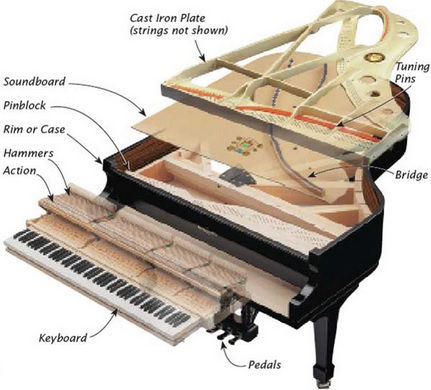
What makes a piano a PIANO? All real pianos have a cast iron plate that looks similar to a harp. This plate makes up a good portion of the pianos weight. Running across the plate are more than 220 heavy gauge strings that are stretched to an incredible amount of tension. Most of the strings are called “plain wire” and cover the tenor/treble area, while the bass strings are called “wound” because they are wrapped in copper. All of these strings are pulled up to an enormous amount of pressure to reach proper pitch. On average, there are about 18 tons of pressure being exerted by all of the strings inside of the piano. Some concert grands reach over 30 TONS of pressure because of their size!

A piano's soundboard is a thin sheet of wood (Sitka spruce) that sits in the "belly" of the instrument which is located underneath the plate. This thin piece of wood is tucked into the case with an extremely tight fit. The resulting tension projects the sound of the piano in to the room. When a technician installs a new soundboard, it is called "belly work". First, the soundboard is carefully placed into the case. Next the plate is secured on top of the soundboard. Finally the strings are pulled over the plate/harp at great tension. Precise adjustments of each string is required in order to achieve beautiful harmony throughout the instrument.

When discussing a piano’s “action”, we are referring to the moving parts. It consists mainly of the keys, wippens, hammers, and dampers. Without the action, the piano is simply a harp. When a key is depressed the many moving parts work in conjunction to correctly strike the strings and produce a tone. Each action has a set of specifications that need to be regulated from time to time to perform properly. The dynamic and skilled process of resetting these precise specifications is referred to as regulation.
I hope you find pianos as fascinating as we do! We are looking forward to diving in deeper to the wonders of the piano. In the future we will discuss in greater detail the piano's action mechanism and other technical aspects of the piano's innerworkings.

